
Face Value
Looking away is all too easy.


In the novel, Theo of Golden, by Allen Levi, a father whose daughter was seriously injured in a car accident confronts a prosecutor helping him in the case against the driver. It turns out this same prosecutor once advised the father to plead guilty to a crime he didn’t commit.
The prosecutor has no memory of the father. Too many cases handled too quickly.
The father understands. He's been on both sides of it. Moreover, he appreciates that the prosecutor is extremely busy and that he deals with people who have done really awful things. Still, he says: “You should look into people’s faces more. There’s some real people in those faces.”
Theo of Golden was recommended to me by author of the Substack Rhetorical Exercise), Chris Douglas.1 Looking into people’s faces is a theme that runs through many of the novel’s peripheral characters (like the father and the prosecutor), and it’s a central commitment of the novel’s elderly protagonist, Theo, who has made a life's work of really looking at people's faces. When he looks into the faces of live people or shares his insights of looking into the faces of portrait subjects, he leaves people feeling seen, connected, and cared about. Those effects, the novel shows, are contagious.2
This isn’t just a sweet story. According to research on face gazing, looking at people has the power to make us feel seen and connected. Looking away does the opposite.
Why We Stop Looking
Looking away from people often feels pretty reasonable. The news is relentless, the suffering overwhelming. The people on the other side of whatever divide you’re navigating can feel less like people and more like aggressors, positions, obstacles—symbols of everything wrong. Sometimes the not-looking is subtle: we quietly shift our gaze, we look down and scroll past. We skip looking people in the face entirely because not only don’t we have the time or the bandwidth, but because, let’s be honest, it’s often easier not to.
The looking away can also be perceptual rather than mechanical. We can, for instance, see a person’s face but catalogue it by parts: we see nose, chin, eyes as separate features. When we perceive people piecemeal, their individuality disappears. So does our ability to detect their emotions, interests, interiority. What's left is easier to dismiss, easier to hurt, easier to treat as though they don’t experience suffering.3
Social scientists who study dehumanization have found that we dehumanize people we already hate, and we also dehumanize people we might want to (or feel we need to) harm, in order to make harming easier. Think about sending someone to prison for a crime they did commit: it would be much harder if you could really see how devastated they were about leaving their kids.
When we stop looking at others in the face, it becomes easier to trade empathy for indifference, and connection for self-protection. It also means that we increasingly become, in small and sometimes large ways, less humane versions of ourselves. This is the cycle that polarization feeds and war accelerates: it becomes easier to look away from suffering, or even to cause it ourselves, when we've already stopped seeing the face behind it. The less we look, the easier it gets not to.
How to Not Look Away
So what should we do with our very understandable impulse to look away? One answer, inspired by Theo of Golden as well as the research on face-gazing, is concrete and simple: look at people’s faces.
Look not just with a quick glance or judgmental assessment. Actually look. Make eye contact with the barista, the colleague you’ve been avoiding, the family member whose politics make your jaw clench (maybe start with the barista). Let their face register as a whole: a person with an interior life, fears, a child somewhere maybe, a story you don’t know as well as you think.
This practice runs counter to our instincts, particularly when we feel threatened or exhausted or morally certain we’re right. And that’s when it may matter most.
One More Reason to Keep Looking
Looking at someone’s face might also be the smallest possible entry point into staying in hard conversations. Researcher Julia Minson, who studies how we navigate disagreement, has a new book out today.4 In her work, she defines constructive conflict in this way:
A constructive disagreement is any disagreement that increases the parties' willingness to talk to each other again.
Pause on that. A wise goal of conflict isn’t to agree or to forgive, but to remain in enough relationship that the conversation can continue. We aren’t likely to stay motivated to keep talking to someone we’ve stopped seeing as human.
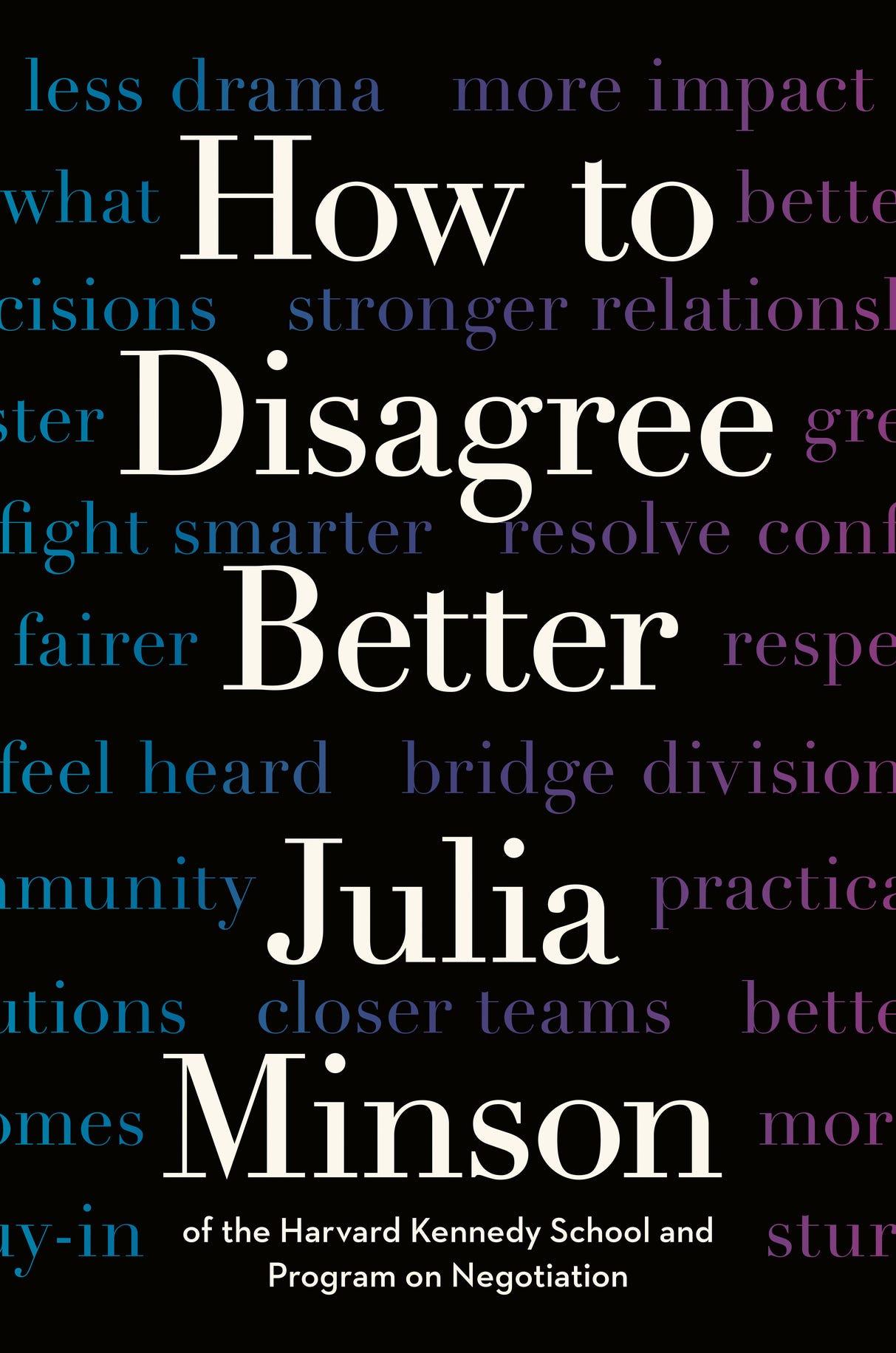
It seems clear that we need an antidote (many of them, really) to dehumanization. One small and important part of the cure may be how we approach our perception of others.
What Looking Can Do
I want to end today’s newsletter with yet one more scene from Theo of Golden, which really captures this idea. It’s again a conversation between the father whose daughter was hurt and the prosecutor:
“Mr. Derrick. Let me tell you what changed me yesterday. About that little man. Up till yesterday, all I had in my head was an idea about him. He was the ‘thing’ that hurt my little girl. And I didn’t mind what y’all did to that ‘thing.’ But what changed me was I looked at his face. Did you look? I mean really look? Not glance. Not a quick peek. I mean look?”
The young prosecutor did not answer. He was beginning to understand what it felt like to be cross-examined.
“Well, Mr. Derrick, I looked. Real good. Real hard. I looked at him. His eyes had tears in ‘em. And I saw hurt and fear, and it changed me.”
That father had every reason not to look at the driver who had destroyed his family’s life. But in that courtroom, he looked—really looked at the defendant. And what he saw when he looked wasn’t the monster he assumed. It was a face wrecked with remorse. A man who had caused harm not out of carelessness, but out of his own desperation to get back to his family. A father, like him. Undone, like him. Just on the other side of a devastation that connected them in ways neither had chosen.
And the looking changed his heart. As the father says:
… When he leaves court tomorrow, I hope he’ll know somebody looked at him and didn’t see a thing or an idea, or a label but a man with a soul. And a man with a child. Even if y’all put a hard sentence on him, I hope he’ll know somebody saw his face.
The act of being truly seen is one of the most powerful things one person can offer another. And it often starts with looking.
If you found this useful, like and share it with someone you care about — ideally while making eye contact 👀 💛 📩. And if a friend forwarded this to you, you can subscribe here.
📚 Paid Subscribers, guess what? Our semi-annual book club meeting is JUST around the corner, taking place on April 15 at 12pm EST (US). We’ll be discussing Naomi Klein’s Doppelgänger: A Trip into the Mirror World—a brilliant, unsettling exploration of how identity, misinformation, and mistaken perception shape who we become. It’s fitting for today’s newsletter because it delves deeply into many of the ways our looking at each other gets subverted. I hope you’ll join what promises to be a fascinating conversation!
Here’s the information to attend (with more reminders to come):
