
Relational SPF: Protect Before You Burn
Books to apply liberally and reapply often.

Hey Riffers,
Quick housekeeping before we get into it: Dr. Tracy Dennis-Tiwary and I are doing another This Is Why You Love It Live this Wednesday at 12pm ET, digging into the psychology of Toy Story 5—what it says about attachment, nostalgia, and why a movie about toys keeps making grown adults cry in theaters. Come join us live, using this link, or catch the replay after!
And now back to our regularly scheduled relationship content.
Summer is here which means it’s (technically) the season of rest, relaxation, and vacation photos where everyone looks suspiciously happy. It is also, in my professional opinion, prime relationship-strain season. Something about the travel, the constant family togetherness1, and the annual beach argument about whether it’s better to be “a planner” or “a vibes” person.2
But so much of the relational strain isn’t, as we might assume, a communication problem or a logistics problem. It’s that we think we’re being clear and we imagine we know what they meant and what they want. We’re often wrong on both counts. This particular flavor of wrong is relationally expensive because our errors don’t just sit there relaxing in the sun. They compound. And they burn.
This is why I put together a list of relationship books to help you prevent the damage this summer. Book-shaped sunscreen, if you will. And credit where it’s due: this list was inspired by my colleague Alison Fragale’s recent LinkedIn post, offering an early-career reading list for young professionals. I loved the format so much I stole it, aiming it at relationships instead of career, and adding my own occupational hazard: reading nonfiction psychology on the beach.
Apply Relational SPF
Here’s where my summer metaphor really takes off: Most of us apply sunscreen before we head to the beach for the day,3 but we treat relationship maintenance the opposite way. We wait for the damage to occur, and then we scramble to repair it.
But we don’t need to wait to apply the relational aloe vera. We can get strategic and protect our relationships for summer sun. I’d argue that we can even enjoy doing it, because part of the preventive care involves summer reads. Yes, you read it right! Nonfiction books about relationship science can be highly enjoyable beach reads!4
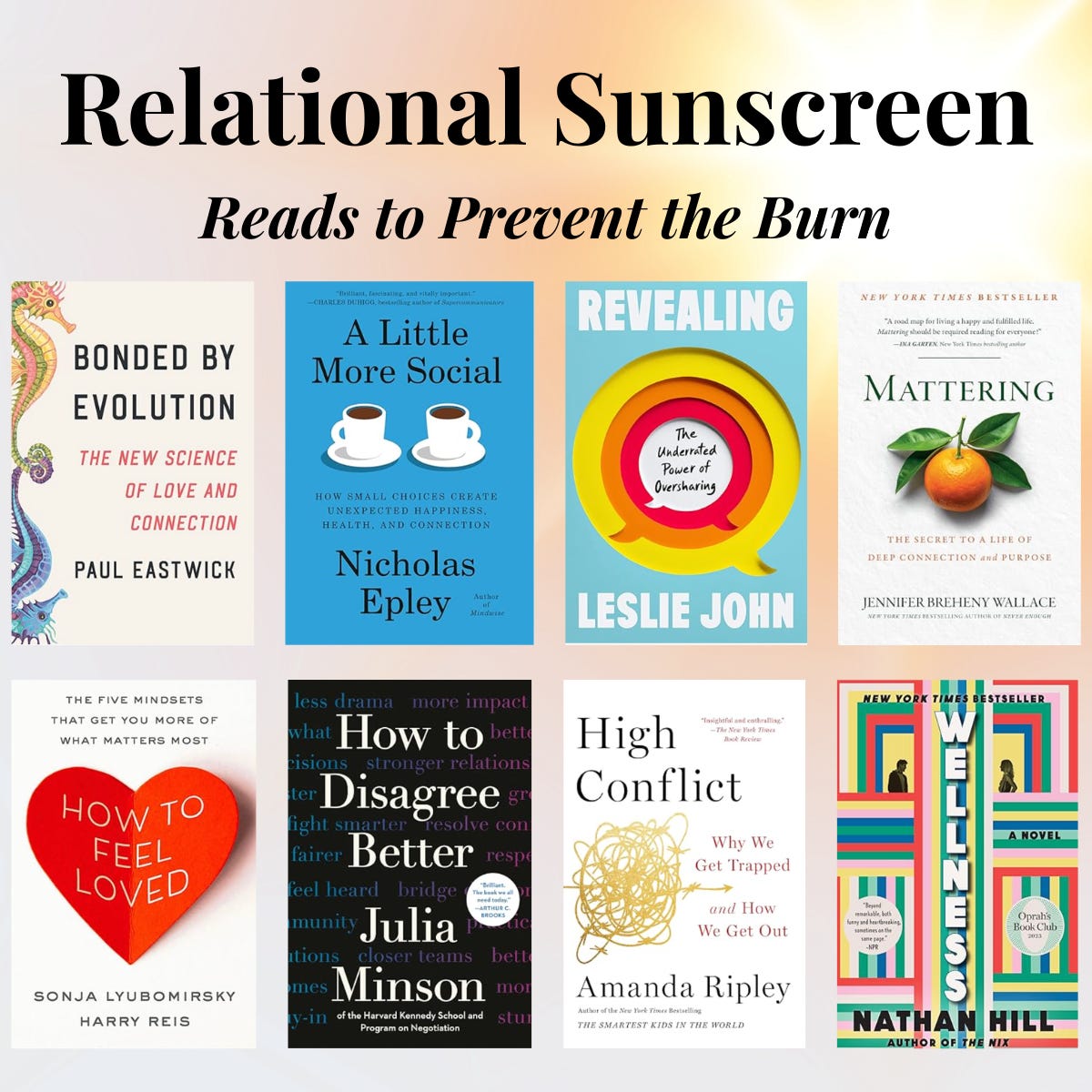
Here are some of the books I recommend most for relationships, from learning to attach in healthy ways to sustaining relationships over time, to recovering from the rough patches. So put on your sunscreen, grab your towel and book, and hit the beach to get relational.
For getting connected:
📖 Bonded by Evolution by Paul Eastwick, on the science of how people actually fall for each other. Paul’s work sits at the intersection of relationship science and evolutionary psychology and disproves a lot of what we’re sold about what causes people to form strong relationships. In brief, it’s less “The Universe brought us together” and more “we kept showing up to create what worked.” Paul explains how compatibility gets created, why physical attractiveness matters less than we think it does, and what the science says about how we can most effectively use dating apps. Must-read for anyone generally interested in relationship science and those who are pursuing partnerships.
📖 A Little More Social by Nicholas Epley, on why our minds trick us into thinking that interactions will go worse than they typically do, or that the benefits of interacting aren’t as positive as they are. Nick’s research reveals that our miscalibrated expectations prevent us from having interactions and forming relationships that really do foster better wellbeing and offers guidance in how to push past the worries to gain a life that’s “a little more social” and a lot happier.
📖 Revealing by Leslie John, on how we worry we’re oversharing, when really we’re underdisclosing. Similar to Nick’s work, Leslie explains that most of us are calibrated to think we are oversharing when, in fact, others are hungry for our more authentic shares. As her research shows, the thing you’re not saying is might just be the thing that would help connect you. Reading about oversharing while wearing your swimsuit among strangers might be your best meta work of the summer.
For strengthening connection:
📖 Mattering by Jennifer Wallace, on the deep need to feel like we are valued and have an impact, and how this may be the core difference in what allows some relationships to bolster our wellbeing, and others to burn us out. Jennie’s book offers guidance in using our small moments of connection, dependence, and even friction to grow, heal, and find meaning. It also explains how to navigate relationships with people who struggle to help us feel we matter, or who reject our messaging that they matter to us. In addition to her talent in translating the science, Jennie is one of the best storytellers I know, making this an ideal beach read.
📖 How to Feel Loved by Sonja Lyubomirsky and Harry Reis, on the habits that make love felt, not just true. Relationship research shows that feeling loved depends less on what’s done for us and more on whether we genuinely feel seen, understood, and connected. Through stories and science, this book shares five different mindsets that can help us feel more loved inside of our most important relationships in a sustainable way. After all, “I told you I loved you in March” is not a renewable resource.
For the hard conversations:
📖 How to Disagree Better by Julia Minson, on fighting in a way that doesn’t cost you the relationship. We aren’t likely to be in a close relationship for long before we… disagree. According to Julia, constructive disagreements aren’t about winning or changing minds, but about elevating our mutual willingness and interest in continuing the conversation and deepening our understanding of one another. For those of us who think disagreements aren’t good for relationships (untrue!) and guidance on how to disagree in ways that bring us closer.
📖 High Conflict by Amanda Ripley, on how conflict gets “stuck” and how to get unstuck. Amanda is another one of my favorite storytellers, sharing fascinating examples of how people go from trapped inside of intractable conflict, to finding the offramp. She explains what conflicts do to our mindsets, how they trap us, but how we can learn to recognize the signs of sticky conflict and shift towards more productive, healthier conversation. No group counseling retreat required!
For Those Who Just Can’t Stomach Summer Nonfiction, a Fiction Pick
📖 Wellness by Nathan Hill. It’s the rare novel that treats relationship science as plot, not just theme (there's even a reference section. Be still my science-loving heart). I don’t want to give any details away but it’s the most clever application of relationship science to fiction that I’ve ever seen and therefore it is and will likely remain one of my all-time favorite novels.
If you’ve got a book that’s saved you from a relational sunburn, please drop it below. 👇
If you loved this list, you might also love my book, Why Don’t You Understand Me?: The Surprising Science Behind Connecting in a World of Missed Signals. It comes out after the summer burn is over, but pre-order now to be eligible for pre-order bonuses!
If this list feels like it has relational saving potential, forward accordingly. And if you're the kind of person who gets a little too excited about book (perhaps relational books specifically 🤓📚), hit that like button so Substack knows to show this to more people like you.
You know it's time for school to resume when the sibling arguments no longer have pauses and instead become one, protracted squabble.
I will not be taking questions as to whether I am “planner” or “vibes.”
Though some of us forget to reapply the sunscreen when we’ve been sitting on the beach for too long after a long, pale winter. Ahem, this would be me. And yes, I did get very crispy this past weekend.
I (can’t promise that I) won’t be offended if you vociferously disagree that nonfiction can offer a delightful beach read.