
On Behavioral Traps with Toddlers and the Myth of Oversharing
On fruit snacks, vulnerability, and that terrifying moment before you click "send."


Hey Riffers,
I’m thrilled to introduce you to today’s guest, a clinical psychologist and researcher who proves that the best insights come from people willing to admit they’re still figuring things out.
Dr. Jasmine Mote is a Research Assistant Professor at Boston University and writes Mentally Healthy, a Substack about the science of pregnancy, parenting, and mental health. With a PhD from Berkeley and a refreshingly anti-expert stance (”I’m just another parent learning things as I go”), she makes complex psychology feel like a conversation with a smart, funny friend.
In our conversation, she shares two scientific findings that live rent-free in her mind: the danger of giving in to your toddler’s tantrums “only sometimes” and why most of us get wrong how much we should share with others.
As you’ll see below the Q&A, I offer a terrific resource for getting social skills-building support and my own personal reflections on Jasmine’s wisdom. I hope you love her wisdom as much as I do.
Q: What’s a scientific finding that lives rent-free in your mind that changed the way you approach relationships? The way you approach parenting?
Jasmine: I’m going to bring up two things here: one lesson from behavioral psychology and one learned in the process of conducting a study.
Intermittent Reinforcement
The behavioral principle I think about constantly is something you learn in Intro to Psychology: the power of intermittent reinforcement. This involves rewarding a behavior occasionally—like giving your dog a treat when they do a trick only sometimes (versus every time, which would be continuous reinforcement). Intermittent reinforcement is more resistant to extinction than continuous reinforcement. In other words, your dog is more likely to keep doing the trick even when you stop giving the treat. If you want to train your dog to keep performing, intermittent reinforcement is the way to go.
I have two kids under four, and mostly I think about intermittent reinforcement because I inadvertently do it all the time (to my annoyance).1 When my son asks to watch one more episode of Dinosaur Train after I’ve already said we’re done with TV, or my daughter asks for fruit snacks for breakfast (when we usually say no), and I give in only once or twice, I’m intermittently reinforcing behaviors that will become harder and harder to stop. This is particularly problematic when I give in after my kids have a bit of a tantrum—they inadvertently learn that tantrums can lead to what they want, even if I only cave every once in a while. Damn you, intermittent reinforcement!

Being Vulnerable
There’s a great Boston-based organization called Skip the Small Talk that hosts events across the country with the intention of helping people have deeper, more meaningful conversations with strangers. Based on research on loneliness and self-disclosure, the events are structured around questions designed to get people to be more vulnerable than they otherwise would be in everyday life. During the pandemic, they made their events virtual, and I ended up doing a study with them showing how their virtual events reduced loneliness and promoted positive emotion in attendees.
I haven’t talked to the founder in a few years, but in our initial meetings, she shared something fascinating. Near the end of each event, the facilitator asks people to close their eyes and answer two questions by raising their hands: 1) Do you feel like you “overshared” in your interactions during this event? And 2) Do you feel like the people you interacted with “overshared” with you?
After years of facilitating these events, she told me that there are always a few people who raise their hand to question #1—they feel like maybe they shared too much of themselves—but almost no one ever raises their hand to question #2, feeling like someone else shared too much.
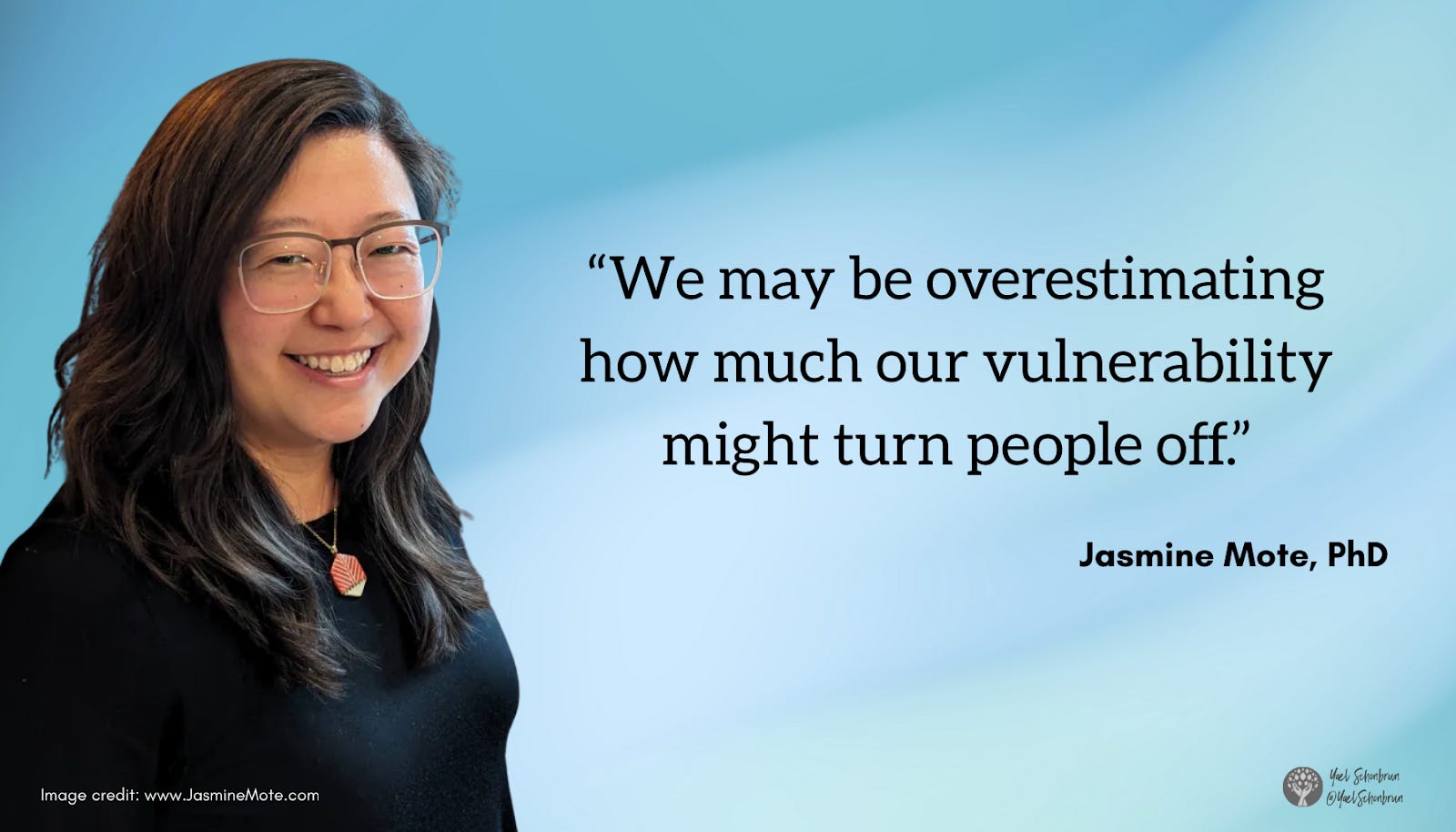
I love this tidbit because it suggests that even when we feel like we’re being too vulnerable or sharing too much about ourselves, even to total strangers, the other person likely doesn’t feel the same way. We may be overestimating how much our vulnerability might turn people off. Instead of being cautious of sharing too much for fear of judgment, maybe we have more freedom to be vulnerable with people in our lives. As someone who has a hard time being vulnerable with others, I think about this a lot and try to push myself outside my comfort zone by reminding myself that what I perceive as “too much” maybe isn’t even that much to someone else.
Think of a time when you decided to share more than you thought was wise. Did it go better than you expected?
Want Help Getting Vulnerable and Connected?
The timing of this Q&A with Jasmine is perfect because my colleague Michael Herold is working on a project at the intersection of vulnerability and connection.
Michael is a confidence coach and social skills trainer writing a book about building self-confidence and meaningful connections in daily life. He’s inviting a small group of coaching clients to work with him and share their experiences anonymously for the book and he’s offering these spots at 50% off his usual rate.
If you’re interested in exploring this amazing resource, you can find details and apply at herold.coach/book.2
On Writing and Vulnerability
The timing of Jasmine’s insights applies to some of my own reflections, as well. I’m about to submit my entire book manuscript to my editor on January 1st.

 | A guest post by
|