
Hard to Love
Lena Dunham on being desperate to connect and guaranteed to repel.

Dear Riffers,
Last week Dr. Tracy Dennis-Tiwary and I hopped on a Substack Live for a new discussion series we’re calling This Is Why You Love It . In this series, we dive down the rabbit hole of entertainment, exploring why we love it and why it’s good for us to love it. In fact, this series was inspired by a 2013 study comparing three interventions to a control condition.1 The interventions: two active couples treatments and… a watch-and-discuss-movie intervention. And guess what, the movie condition did just as well as actual therapy for relationship outcomes! If research shows watching movies together is good for us, who are we to argue?
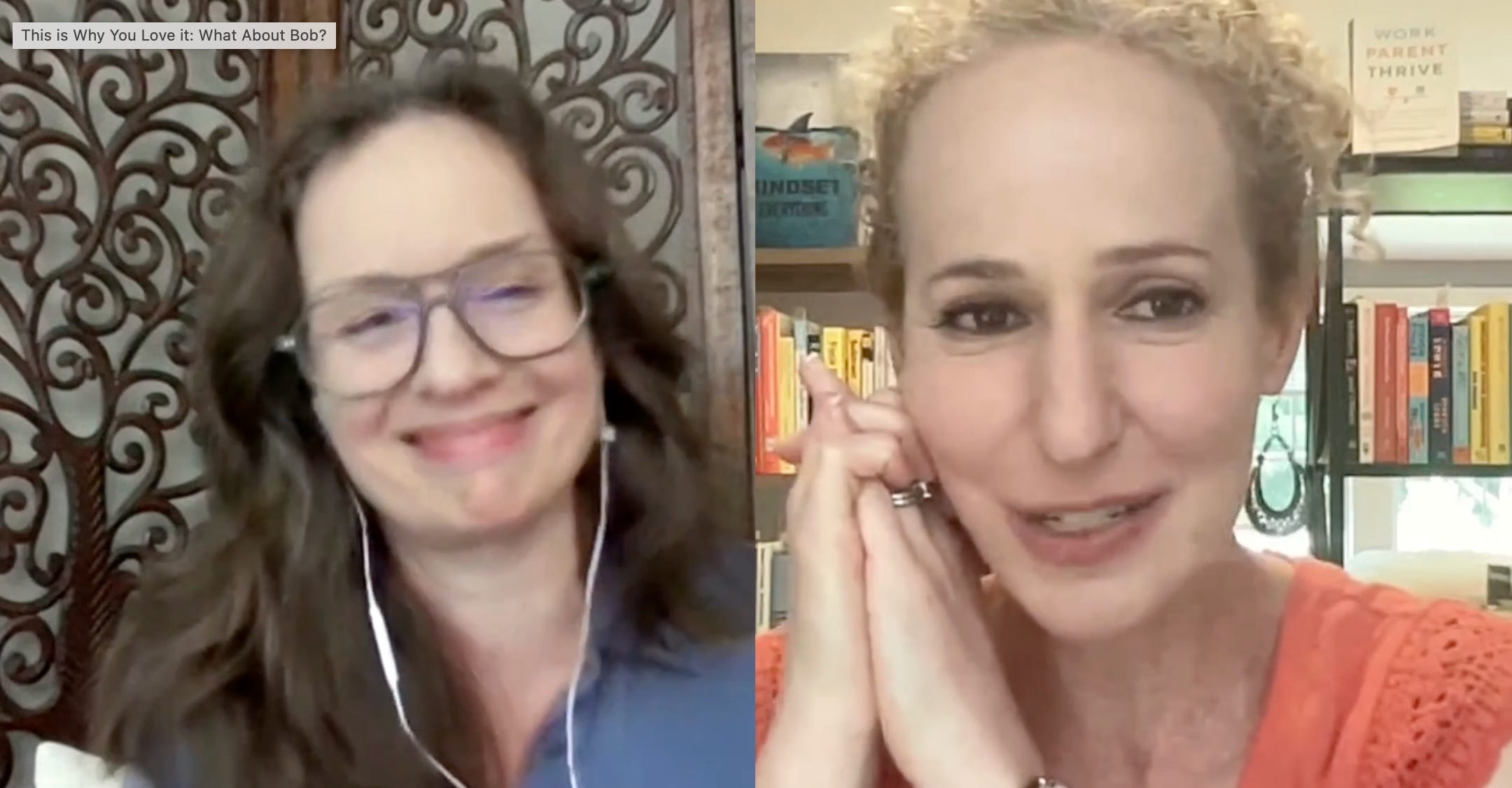
Our first discussion focused on the 1991 classic starring Bill Murray and Richard Dreyfuss, What About Bob? But one thing we didn’t have time to get to was the real-life relationship between Bill Murray and Richard Dreyfuss. It was, shall we say, not good.2
Celebrity lives and relationships fascinate us. Which is the perfect segue to this week’s topic: why writer, actor, and director Lena Dunham is sometimes loved, sometimes reviled, and quite often just entirely misunderstood.3
The Need Beneath the Noise

Lena Dunham’s hard-to-put-down4 new memoir, Famesick offers a treatise on what it's like to be desperate to connect yet too often misunderstood.
Dunham burst onto the celebrity scene at age twenty-four, with her semi-autobiographical film, Tiny Furniture. It won the Independent Spirit Award for best first screenplay and led to all sorts of offers, including from HBO, where she came up with the idea of a series that would fully launch her into the public eye: Girls.
In surreal fashion, Dunham writing, directing, and starring in Girls meant she was creating art about twenty-something women trying to find themselves while simultaneously being a twenty-something-year old trying desperately to find herself. But unlike the characters she was writing, she wasn’t just barely making it in New York—she had made it. And the fact of her success meant she was responsible for the livelihoods of hundreds of people working on the series.
As the pressures and publicity mounted, she tried to keep her head above water and sustain the relationships that were, for her, the very heart of it all. As she writes:
Contrary to what some people believe, I never got into this to offend anyone. I did it to connect.
[Note: I listened to this book rather than read it, so quotes are transcribed as carefully as I could manage rather than copied directly. Apologies for any inaccuracies.]
The need for understanding is as universal as the need for belonging, because really, they are one and the same. And Dunham describes herself as exquisitely hungry for understanding, deeply wounded when the need is thwarted. She recalls an instance of meeting up with old friends during a busy season of Girls in which she had lost her voice. She didn’t bail because she wanted her friends to know they were a priority. But later, she learned they viewed her showing up and writing to communicate as a form of attention-seeking rather than a sign of friend-devotion.
When More Backfires
As Dunham’s success grew, so did her struggles: trauma, a chronic illness that took years to diagnose, an addiction born of trying to manage both. Through it all, Dunham continued to fight to be understood, to give others enough that they would love and understand her as worthy, whether the offers were artistic, financial, or energetic.
In 2016, after the presidential election where she threw her celebrity status behind Hilary Clinton, the misunderstanding and rejection reached a new crescendo. She writes:
I knew the internet had become, once and for all, a place where I was absolutely guaranteed to find pages and pages daily of abjectly cruel messages, things the meanest teenager wouldn’t even say to the most deserving mother… It seems to me, looking back, that I thought the cure for such widespread disdain—some of it personal, some of it political, a lot of it the result of toxicity breeding only more toxicity—was not to show less of myself but to show more, as if revealing myself down to the guts would allow for some kind of renewed understanding. I was, in hindsight, just begging. And what are we humans better at than averting our eyes from a beggar?
Her experience reflects an unfortunate but predictable feedback loop: pursuing understanding so intensely can all but guarantee misunderstanding.
The Closest Knife
Among the most painful misunderstandings Dunham describes wasn’t with strangers on the internet or the doctors who didn’t listen to her. It was with Jenni Konner, the Girls showrunner.
From the start of the series, Dunham and Konner’s lives became intertwined professionally and personally and with what seemed like a true and caring devotion. But as Dunham looked back in the aftermath of illness, addiction, and heartbreak, she could see that Jenni’s motivations were a mix of love and professional ploy. In hindsight, she could see that Konner had pushed her to keep working even when she was sick, to take medicine rather than slowing down to wonder what was really going on medically, and dismissed the cruel analysis being foisted on her from every direction rather than appreciating the pain of it. The person who she thought understood her most unconditionally, it turned out, also had motivations not to understand.
Dunham describes begging Konner to try:
The triad of illness, trauma, and addiction was more than I had been able to bear. Everything that had happened publicly was harder than I let on. But it was real—it could be clearly laid out on a timeline, like in a history book or a true-crime podcast… And now, I told her, I was still dealing with the physical pain of an incurable condition, a condition I had never taken a moment to consider the emotional implications of.
Konner responded:
But you keep saying you’re sick… like you still believe it’s physical.
She thought Dunham was “clinging to this random diagnosis like it’s an answer.”
When strangers misunderstand you, it’s often because they lack information or don’t think it’s worth putting in the energy to understand. But someone who knows you, who has invested in you, and who still won't see you? That's a wound that can feel intolerable.
The research bears this out: on days people feel better understood, they report higher life satisfaction and fewer physical symptoms. When researchers experimentally induce feelings of being misunderstood and then ask participants to complete seemingly unrelated physical tasks, they find that those who feel misunderstood show reduced pain tolerance.
Dunham didn’t give up on understanding easily. Hurting but still hopeful, she told Konner that she would like to meet in a therapist’s office to figure out what to do with their shattered relationship. Minutes in, the therapist notes that the question seems to be whether they can salvage a friendship from their wrecked business partnership. To this, Jenni simply… shrugs.5
Dunham writes about what happened next:
She turned to me. ‘I have just one request.’
‘Anything,’ I said. ‘Really, anything.’
‘Please don’t write about this immediately. I know how you work and that you will, but please, just not right away.’
She knew me, she knew my process better than anyone…. I felt myself say goodbye to all of this knowing and being known and tried to summon a perfect response, something that expressed that I knew all the ways this had been hard, all the ways I had been hard—hard to corral, hard to understand, hard to love—all the ways she had been my best and always, had confounded me and terrified me, made me my best and worst.
But then she began to gather her things: purse, phone, a CVS bag, and stood. ‘Thank you for your help,’ she said to the therapist.
With 47 more minutes left to go in their first session, Konner departed. Dunham, doing her best to abide by Konner’s request, waited seven years to write about it.
Upgrade to keep reading: the realizations that save relationships and what research says about finding the people worth the understanding effort. (I wrote a whole book about this, out October 27th. Pre-order if you are able!)
