

Dear Riffers,
Here’s a question that comes up a lot in the couples’ therapy room and in everyday life: “Do you owe understanding to someone who hurt you?” and “Do you owe understanding to those who hold what you see as harmful beliefs?”
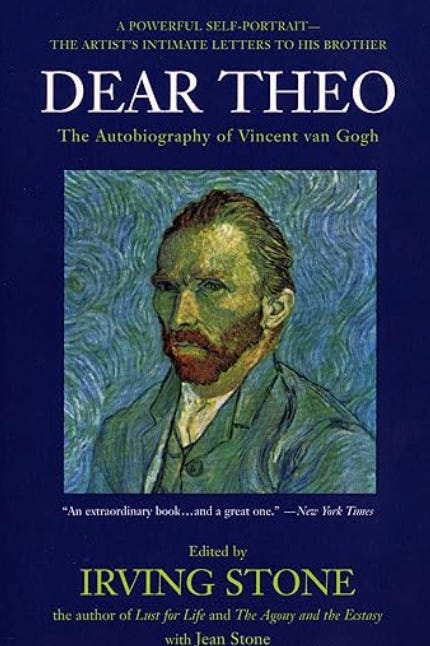
Boston’s Museum of Fine Arts recently had a Van Gogh exhibit1 that sent me down a rabbit hole of reading a book of letters from Vincent to his brother, Theo. In those letters, you see so much of the complexity of Vincent Van Gogh’s inner world: his genius, his love for so many people, his passion for nature, his deep philosophical thoughts2. But what struck me most was his loneliness.
Despite a brain and a heart brimming with passion and insights, he could seldom find anyone interested in him as a friend, let alone anyone who could understand what he was trying to say or do. As Irving Stone writes in the preface to the book:
Vincent Van Gogh was one of the world’s loneliest souls.
Just one person stood by Vincent throughout his difficult adult life: his younger brother Theo, an art dealer in Paris. Where Vincent faced rejection in romance3 and friendship, it was Theo who remained steadfast.
Vincent’s hundreds of letters to his brother reveal a relationship that was both profound and profoundly demanding. Passionate observations about art, nature, and expressions of deep appreciation and connection are punctuated by recurring requests for money. The pattern repeats across years:
In 1883, Vincent wrote:
Now you say, to my disappointment: ‘I have so much to pay that you must try to manage till the end of the month.’ Am I less than your creditors? Who must wait, they or I?
At one point, a harsh accusation:
You have never sold a single one for me—neither for much nor for little. In fact, you did not even try.
Vincent was asking his brother—his sole source of support, the only person standing between him and destitution—to prioritize him over Theo’s own debts. He seemed to know the weight of what he was asking. But he asked anyway, because without the money, he couldn’t paint.
Vincent often seemed to have insight into the complex nature of their relationship and its effect on Theo:
I am awfully sorry that I am a burden to you... if the situation is too much for you, tell me so plainly; I should rather give up everything than put too heavy a burden on your shoulders.
It would be easy to read these letters and wonder whether Theo should have set firmer boundaries, insisted Vincent get a real job, protected himself more. These are fair questions. Theo himself may have wrestled with them.
And yet, without Theo’s sustained faith in Vincent’s essential worth—his genius, his sensitivity, his capacity for beauty—the world would never have received Starry Night, Sunflowers, or the profound insights about color and light that changed how we see. What looked like poor boundary-setting from one angle was, from another, an act of uncommon love and faith.
Was it worth it for Theo? We can’t know. He died just six months after Vincent.
We might aim to address this question through Vincent’s artistic legacy. But that’s using outcome to justify process, which isn’t a tool we can use to make decisions (because… There is no outcome when we have to make them!).4
The real question—the one that applies to our own messy relationships for which we cannot know the outcomes—is whether efforts in understanding someone difficult have inherent value, regardless of what they produce or become.
What Do We Owe Others in Our Relationships?

In close relationships, we all feel we are owed things. And we are. Safety. Honesty. Basic respect.
But the notion of owing understanding to others is more complex. After all, it’s hard to open ourselves up to understanding others if we don’t feel safe with them.
So when hurts happen—infidelity, cruelty, betrayal—and we begin to question how much we’re willing to tolerate, we inevitably ask: “How much is too much?” “Do I owe it to my partner/friend/parent/colleague to try to understand where they’re coming from?” “Do I owe it to them to understand why they would hurt me?”
We might be asking the wrong questions.
The problem with “Do I owe them understanding?” is that it puts us in an impossible bind. If we say yes, we risk sacrificing ourselves on the altar of compassion. If we say no, we risk becoming the thing we hate: someone who cuts others off, who refuses to see their humanity, who treats people as disposable.
We decide someone is too vile to understand, then reject them in ways that mirror the very cruelty we’re protecting ourselves from. The person we’re condemning for being hateful? They experience our condemnation as hateful too.
This is the bind we find ourselves in. So maybe the question isn’t “Do I owe them understanding?” but rather: “How can I make choices that align with who I want to be, even when others are behaving or believing contemptibly?”
This reframe does something important: it takes the focus off what we owe others and puts it back on who we choose to be in difficult relational circumstances. It acknowledges that we get to choose. And it makes clear that both self-protection and compassion can be choices we make intentionally, rather than obligations we’re trapped by.
When Safety Comes First
But first, a crucial distinction. Before we discuss what understanding as a choice looks like, we need to discuss when it doesn’t apply at all. If your partner is abusive, your job is not to understand them—it’s to get safe. Full stop. Understanding can come later, if at all, and ideally with the support of a therapist or other qualified person who can help you process what happened without requiring you to make yourself vulnerable to someone who will not prioritize your safety.
Safety assessments matter. Patterns matter. When someone repeatedly shows you who they are through their actions, believe them. Understanding their childhood trauma or their mental health struggles doesn’t obligate you to remain in harm’s way.
But even here, even when leaving is absolutely the right call, you can leave without flattening someone into a cartoon villain. You can say, “This person hurt me and I had to protect myself” without also saying, “This person is pure evil and irredeemable.” Not because they deserve your generosity, but because that kind of black-and-white thinking doesn’t serve you. It makes you smaller, more rigid, less capable of nuance in all your relationships.
Understanding as Choice, Not Obligation
Here’s what understanding as a choice looks like in practice:
You can choose to try to understand why someone acted the way they did or believes what they believe, not because you owe it to them, but because understanding helps you make sense of what happened and decide what comes next.
Understanding doesn’t mean staying. It doesn’t mean excusing. It means trying to see others more clearly.
You can also choose not to understand right now—not because they’re not worth it, but because you need to protect yourself first. You can recognize that understanding requires emotional resources you don’t have, and that’s okay. Not trying to understand someone doesn’t make you cold; it makes you human.
The key is in how you hold these choices. You can refuse to tolerate abuse while still recognizing that the person abusing you is struggling with something difficult (even if that something is not your responsibility to fix). You can protect yourself fiercely (including by ending the relationship or setting a firm boundary) and still treat the other person with basic dignity.
This isn’t easy. It requires holding two truths at once: that you matter, and that they’re still human.

The Gift of Understanding
In one letter, Vincent captured his own predicament in words that read like a definition of being misunderstood and the power of being understood:
